A comment on a recent blog post took me back to the final years of my oil painting career. The commenter wanted to know if yellowing paper was why I started using umber underdrawings. It’s not, but I decided to explain why I use umber underdrawings for so many colored pencil works.
Those years of oil painting had a direct effect on the way I use colored pencils now, so let’s begin with a bit of background in oil painting.
Don’t worry. I’ll keep it brief.
The Flemish Method and Oils
The Flemish method is a classical method of painting that involves seven distinct steps. That’s why it’s also called the Seven-Step Method. The steps are:
The Imprimatura
Preparing the painting surface with a thin layer of a neutral color. In my case, an earth tone. This is done before the line drawing is transferred. Here you see the imprimatura with the line drawing transferred.

The Umber Layers
After the line drawing is transferred and made permanent with ink, painting begins with earth tones. The focus is on big shapes and the major values.
The umber layers usually take shape in two rounds. The first layer establishes the composition. The second umber layer builds on the first. Details are developed, and values are refined.
My umber layers weren’t usually as detailed as they could have been. I was too impatient. This is the umber layer after the first round was nearly complete. Notice I’ve done nothing with the rider and not much with the cows.

The Grayscale Layer
After the umber layers are complete and completely dry, the painting is painted over with a grayscale layer. The best way I can describe this is by saying that the finished grayscale layer should look like the painting viewed in the light of a full moon.

The First Color Layer
In the first color layer, the colors are all applied in thin glazes, so that the work already done shows through. Color is applied in each area based on the final colors of the painting. For example, a red rose gets a glaze of red. The leaves get a glaze of green. The finished layer can look almost like a stained glass piece with all the details showing through.
This shows the painting with most of the first color layer complete.

The Second Color Layer
The second color layer develops the colors further. There may be some blending, not by mixing paint, but by glazing one color over another. A yellow glaze over a blue glaze creates an area of green.
This phase may require many layers to get the subtle gradations in color and value that are necessary for the finished painting. But all the layers are transparent or semi-transparent.

The Detailing Layer
The final step is the detailing layer, and it’s here that the oil painter uses opaque color for the first time. The highlights are usually the most opaque. The darker values are still quite thin.
Detailing continues until the artist is satisfied with the look of the painting.
As you can see in comparing this image with the one above, I spent a lot of time in the detailing phase. That was my favorite part.

Why I Use Umber Underdrawings
The Flemish Method of oil painting cannot be translated directly into colored pencils. Adjustments are required. But it is doable, and it is a very good method for use with colored pencils.
I suppose the simplest reason I use umber underdrawings so often is that it was natural. I started oil paintings with umber underpaintings; why not start colored pencil drawings with umber underdrawings?
But there’s more to it than that.
Using an Umber Underdrawing Produces Better Artwork
I noticed an immediate improvement in my oil portraits when I began using the Flemish method. With some adjustments to fit my style, it helped me produce some of the best portraits I’d ever done.
But it’s designed for oil paints, which can easily be thinned with painting medium. It’s not for a dry medium like colored pencils.
So when I switched to colored pencils, I had to make more adjustments. Moving from a fluid medium to a dry medium was the biggest adjustment. Working on paper that sometimes cannot take many layers was also a challenge.
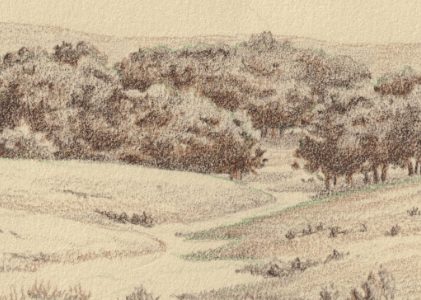
But even with those challenges, I still found that using an umber underdrawing almost always produced better artwork. The earth tones are especially helpful in creating realistic landscape greens. This is one of the first landscapes I drew with colored pencil and I started with an umber underdrawing.

Other Reasons to Use an Umber Underdrawing
Working Out the Composition in One Color
Another reason I like to begin with umber underdrawings is that they allow me to work out the details of a drawing without worrying about color choices. Yes, I can do both, and have for many pieces.
But drawing shadows and refining details is much easier when I limit myself to one or two shades of brown. The more complex the composition, the more important this step is to me.

Finding and Correcting Mistakes is Easier
Since I use light pressure for all or most of the umber underdrawing, it’s much easier to make corrections. Lifting color is easier because there isn’t as much color on the paper.
I can then shade over them with fresh layers of brown. By the time I’ve added the color layers, the corrections are invisible.
Spotting Unrecoverable Errors is Easier
One of my biggest challenges in creating art is discovering serious compositional errors on a work-in-progress. That is one of the biggest reasons I end up with so many unfinished pieces. It’s one thing to create a beautiful line drawing, but sometimes those line drawings don’t turn into beautiful artworks without revealing some serious warts!
Working through the umber underdrawing phase first helps me spot errors of all kinds at an earlier stage in the drawing process. If I can correct the errors, it’s easier to correct them in the umber underdrawing phase.
If I can’t correct the error, then I haven’t invested as many hours or as much effort into the drawing. It’s easier to let it go and start over.
Or to see that a drawing just isn’t viable in any form. That does happen, too; yes, even to the best artists.
Why I Use Umber Underdrawings
Those aren’t the only reasons I like using umber underdrawings so much, but they are probably the most important reasons.
Can you use umber underdrawings even if you’ve never used oils? Absolutely! Just do the first few layers with a medium-light value brown instead of beginning with color. When you like the umber layers, then begin glazing color.
It’s as easy as that!
Sign up for Carrie’s free weekly newsletter and be among the first to know when she publishes new articles.