

We’ve all heard a lot about Prismacolor colored pencils. I’ve written about them several times. Today’s post starts off with Prismacolor pencils, but it’s actually more about a fade proof fixative for fading colors.
A reader got me started on this topic with the following comments and question.
I know that many artists are concerned by negative quality control issues within Prismacolor pencils, such as breakage of the color core, the core not being centered during manufacturing, and the quality of the wood casing.
My concern is lightfastness. More than 50% of the pencils are rated lightfast 3, 4, or 5, and are likely to fade over time.
I’ve avoided using colors with lightfast ratings of 4 and 5 (understanding lightfast 3 is borderline lightfast).
My question is whether there is a fixative or other preservative that might extend the lightfastness of those colors?
This is a great question. Lightfastness is a concern for a lot of artists, myself included.
Fade Proof Fixative for Colored Pencils
I understand this artist’s concerns about Prismacolor pencils. I share them all.
But as annoying as breaking pencils, cracked casings, and off-center pigment cores can be, they are tolerable.
Fading colors are a bigger problem, especially for artists who do commission work or sell originals. I’ve gone so far as to remove all the non-lightfast Prismacolor colors from my tool box, including those rated at 3. I use those colors for non-art things, but not for artwork that I want to last.
At one time, I used Prismacolor pencils almost exclusively, but now Faber-Castell Polychromos pencils are my go-to pencils. I supplement that color collection (which is almost entirely lightfast) with the lightfast colors in the Prismacolor line. I can do everything I want to do with those combined colors.

Keeping Fading Colors From Fading
Unfortunately, there is no way to keep fading colors from fading, since the problem is in the pigments used to make the colors, not the way the pencils are made or used.
You can still use those colors for other things. I use the fading Prismacolor pencils for my task tracker, for adult coloring pages, and so on. I even use Orange, Light Aqua, and Apple Green to highlight my Bible. That has shown me that some of those colors fade even when they are not in direct sunlight! No fixative can prevent that.
Ways to Possibly Slow Down the Fading
If you like using fading colors and don’t want to give them up, there are a few things you might try. You won’t be able to prevent the fading, but you may be able to slow it down.
The first and most important is to not display artwork in direct sunlight or in places where it might get a lot of sunlight for any length of time. The ultraviolet waves in sunlight contribute to fading, so avoiding it is helpful.
Using UV resistant glazing in framing is also helpful. This type of glazing filters out UV light and keeps it away from your artwork. That slows down much of the fading you might see with those non-lightfast colors.
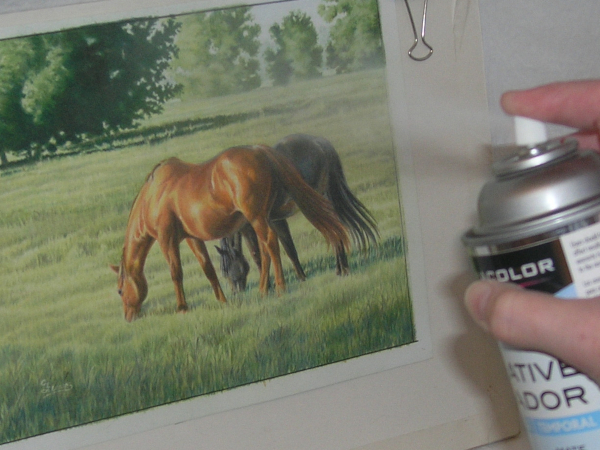
There are UV resistant fixatives on the market. Krylon UV-Resistant Clear Acrylic Fixative is one that’s available through Dick Blick, but there are others. Make sure to check the type of finish. This Krylon fixative comes in two forms, matte and gloss, for example.
You’ll also need to make sure it’s suitable for use on paper and won’t stain or discolor your artwork.
Fade Proof Fixative for Colored Pencils
None of these options stop fading; they just slow down the process. And some colors will fade quickly no matter what you do. Prismacolor Orange and Light Aqua both fade in a couple of years in a closed book.
So the best solution is to not use the non-lightfast colors in artwork that you want to last or to find similar colors in other brands that use better pigments. Be warned, though. Those alternative colors will probably be more expensive because the pigments are more expensive.
But even so, that’s less costly than putting hours into a drawing that fades to a ghost of itself in a few years.
Got a question? Ask Carrie!


Great advice and something to consider when creating our precious works of art.
Another good idea to consider is to have your original art scanned. Scanning the original piece not only retains the integrity of the work itself, but will also allow you to create limited edition prints should you elect to market your work in this manner. If stored properly, the original can be kept for future use and/or further prints, or eventually sold as “original”.
In this age, we have the technology to accurately reproduce copies using quality archival pigments that have been tested to survive decades provided that they have been properly matted and framed with archival components complete with UV glass for display purposes. The pigment inks used in the reproduction process these days far outweigh and outlast the light fast ratings on most coloured pencils on the market these days. Choosing the correct service provider is important however when considering an option such as this.
Kim,
Scanning artwork is a good idea. I do it regularly for my records, as well as for posting and publishing.
And if an artist’s goal is selling reproductions, then it is okay to use non-lightfast colors, since the inks used in most printing processes are archival.