Today’s reader question is about method; in particular, the colors to use for a monochrome underdrawing.
I want to try a monochrome underdrawing for colored pencil. What colors can I use?
The short answer is that you can use any color you want. That’s one of the great things about being an artist!
Neither art nor life is as easy as that, though.
While it is true you can use any color you want for a monochrome underdrawing, not all colors are good choices. The color you choose will greatly affect the look of the finished drawing, so you need choose carefully. Believe it or not, it is possible to ruin a drawing in the underdrawing phase.
I know.
I’ve done it!
Tips For Using a Monochrome Underdrawing
Two main guidelines you should pay special attention to are:
Don’t use very light colors
Don’t use very dark colors
Colors that are too light in value won’t do you much good.
Light colors might seem like a natural choice, but they aren’t. If you choose a color that’s too light, it’ll have little or no impact on the final color.
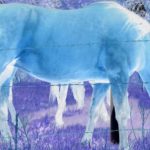
I chose colors opposite the color wheel from a deep chestnut for this underdrawing. Prismacolor Apple Green for the horse and Prismacolor Grass Green for the tack. I soon learned they were too light to make an impact on the final drawing.

So be wary of using lighter colors. They simply may not be bold enough to make much difference to the finished drawing.
But don’t go too dark, either!
You can get away with dark colors more easily than light colors, but you also run the risk of getting the underdrawing so dark, color glazes will be ineffective.
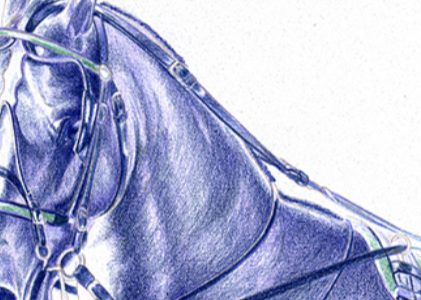
I chose a dark blue for this drawing because the horse was a darker brown and because the horse was back lighted.
This underdrawing looks great, doesn’t it?
I should have left it this way. Every color I added made the drawing darker and darker until there wasn’t much room to add the necessary details. The finished drawing was too dark and vague for my liking, and just didn’t turn out to expectation.

If you are able to apply color with very light pressure—whisper soft pressure—then dark colors can produce excellent underdrawings.
But if you’re a bit heavy-handed or just aren’t confident in your ability to produce light pressure, you’re better off steering clear of dark colors.
And there is one other thing you need to be careful to do.
Colors you might want to stay away from if you’re doing a monochrome underdrawing.
As you may know, complementary colors appear opposite one another on the color wheel. Yellow and purple are complementary colors. So are red and green.

Technically speaking, a monochrome underdrawing can also be a complementary underdrawing. Complementary underdrawings are great for drawing almost anything.
But I generally keep the two drawing methods separate. I use the complementary method often enough that if I really want to use a single color for an underdrawing, I steer clear of complementary colors.
The same holds true for earth tones, since I use earth tones for the umber underdrawing method.
Does that mean you can’t use complementary colors or earth tones for your monochrome underdrawing?
Absolutely not! I’m just telling you why I don’t use complementary colors or earth tones for a monochrome underdrawing.
If you’ve never used a single-color underdrawing before, the color wheel is your treasure box! Use whatever color you want!
In fact, try them all (on different drawings, of course!).
A fun and easy drawing exercise to get started.
Pick six to twelve colors at random out of your pencil collection. Shade each color with medium pressure (or several layers of light pressure) on a piece of paper. To keep things simple, make each swatch as even in color and value as you can.
Then choose a different color, and layer that over each of the color swatches. You want to see how the underdrawing colors affect the surface color and this is a fast and easy way to do that.
If you want a bit more in-depth test, make each color swatch range in value from as light as you can make it to as dark as you can make it. Then do the same with the color you layer over the underdrawing colors.
I’m guessing it won’t take you long to discover which colors work for an underdrawing and which aren’t suitable.
Conclusion
As I stated at the beginning, you can use pretty much any color you want for a monochrome underdrawing.
Some colors will hinder you more than help you, though, so take time to experiment before you start the drawing. You’ll be glad you did.
If you have a question, leave a comment below.
Want to know if the monochromatic drawing method is the best method for you? Read Comparing Colored Pencil Drawing Methods.
Sign up for Carrie’s free weekly newsletter and be among the first to know when she publishes new articles.