

The topic for today is a drawing method that most of you probably do not usually consider. What is it? Using a green underdrawing with colored pencils.
Formally known as a verdaccio, this technique is a very old and honored painting method used by many Old Master oil painters and fresco artists.
But it is possible to use it with colored pencils, too, and I’ve done it.
Green Underdrawing with Colored Pencils
What is Verdaccio Anyway?
Painters who use the verdaccio method of painting start out by mixing black, white and yellow to create a soft, greenish-brown. The exact shade of green can be adjusted by adding more or less black and/or white, so it’s possible to create a nearly full range of values with these three colors.
This mixed color is the basis for the underpainting. The full painting is underpainted with each value in place and the different parts of the composition mapped out. The result can be a half-tone painting that looks like a finished painting viewed in dim light. Once the underpainting is dry, colors are glazed over it to bring the painting to life.

I’ve talked about the Flemish method of oil painting in the past, and how I adapted it for colored pencils. The illustration above is a sample of that kind of underdrawing.
Verdaccio is similar to the Flemish method, but simplifies it a step or two, and uses green for the underpainting instead of brown.
Verdaccio was once a primary part of fresco painting. Probably the best known example of this painting method is the Sistine Chapel by Michelangelo. In some areas, the verdaccio underpainting is still clearly visible.
Reasons to Use the Verdaccio Method
The purpose of any limited palette underpainting is to provide a foundation for the artwork. It’s also a way to figure out values and shapes without also having to make color decisions.
Using a verdaccio or any type of underdrawing also gives a painting depth and can produce rich and luminous colors. You have only to look at the work of the Old Masters who used a method like this to see the results.
As I mentioned above, many Classical paintings—and especially fresco paintings—actually use the color of the verdaccio to define part of the finished painting. For example, I mentioned Michelangelo’s Sistine Chapel work above. The people and angels in that work are all in full color, but other portions are the verdaccio.
You don’t have to leave any of the underdrawing visible. I never have, but I can see the value in using an underdrawing this way with drawings that include trees or other elements that I want to remain in the background.
An Example from a Current Work
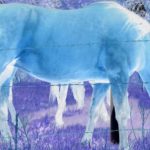
This is the verdaccio (green underdrawing) for a portrait of a Belgian foal I did a month or two ago. I used only one color, Prismacolor Prussian Green, to create this underdrawing.

I used the underdrawing to make sure the drawing was correct, to work out the shadows and highlights, which are somewhat complex on the forehead and neck, and to decide how much detail I wanted to include in the neck. This foal was pretty stocky and the way he’s holding his head produced a lot of wrinkles on the neck. Did I want to draw every wrinkle or only the main ones? I was able to make that decision as I worked my way through the green underdrawing.
One Final Note
I’m currently teaching a workshop on this process using this drawing. Ann Kullberg is hosting the workshop, which began October 26 and runs every other Saturday through December. As I write these words, two sessions have already met, and I’m preparing for the third.
But it’s not too late to join us. If this drawing method appeals to you, you can still join here. You will have access to all past videos, to my posts on Padlet and the posts of students. You will also have direct email access to me so you can catch up.
One additional bonus: I’m also writing step-by-step tutorials for each session, including the underdrawing phase. You will have access to those, as well, no matter when you join the workshop.
But don’t wait. There are only a few seats remaining, and you get the videos, emails, and tutorials only if you join the workshop. They will not be made available anywhere else.
So I hope to see you for the next session!



very interesting. In my teenage art lessons, we didn’t do underdrawing, but our teacher always had us mix our greens from a yellow and black, white as needed. Now i have a name for the color. Thank you!
Valerie,
I have mixed a green with yellow and black when I was oil painting. Unfortunately, mixing black and yellow with colored pencils doesn’t produce green.
Verdaccio is an interesting drawing method. I’ve used it on two chestnut horses so far. I’m wondering how it would work with a landscape.
I’m glad you enjoyed the article, and thank you for leaving a comment.
On your sample drawing showing this unique technique, will you share your finished piece so we can see the progression? This was an very interesting article. Thanks so much.
Patricia,
I can share the finished piece, but not the step-by-step because this is the project drawing for the Beautiful Belgian workshop, hosted by Ann Kullberg. It’s a paid class, so I’m limited on what I can share here.
But there may be more horse portraits with a green underdrawing in the next year, so stay tuned.